
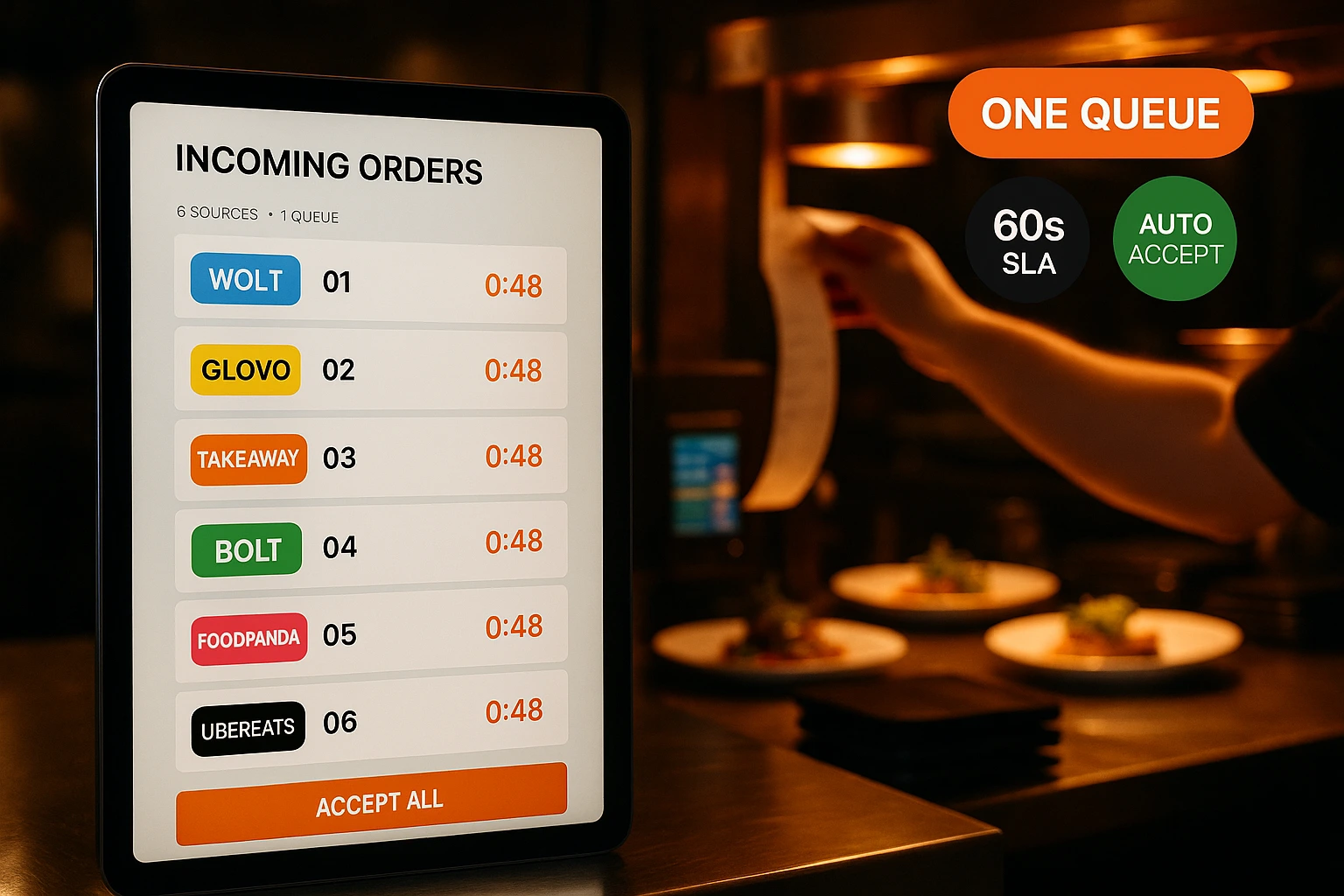
All Your Marketplace Orders in One Place
Receive orders from Wolt, Glovo, Takeaway, Bolt Food, Foodpanda, and UberEats directly in the Ordering.Tools admin and KDS — same screens, same printers, same notifications as your direct orders.
What Is Marketplace Order Aggregation?
If you are listed on multiple delivery marketplaces, your team has to juggle a separate tablet for each one. Orders arrive in different formats, on different screens, and the kitchen has to translate between them all. Marketplace aggregation pulls every order into one queue, so the kitchen sees one ticket regardless of where it came from.
Each marketplace gets its own native integration — Wolt Order API, Glovo Partners API, JET Connect, Bolt Food Partner API, Delivery Hero Partner API, and UberEats Marketplace API. When a customer places an order on any platform, it lands in your admin within seconds, prints to your kitchen printer, lights up the KDS, and starts the same notification flow as a direct order. Status changes flow back to the marketplace automatically, so the customer always sees an accurate ETA.
Why One Queue Beats Many Tablets
One Queue, Six Marketplaces
Wolt, Glovo, Takeaway, Bolt Food, Foodpanda, and UberEats orders all land in the same admin and KDS. No tablet wall, no cross-checking screens.
Automatic Accept-Back
Every marketplace has a strict accept-back SLA — usually 60 seconds. Orders are confirmed back to the platform automatically the moment they hit your admin.
Status Sync to the Customer
When you mark an order as preparing, ready, or out for delivery, the marketplace gets the update right away. Customers see the same status the kitchen sees.
Same Notifications, Same Workflow
Marketplace orders trigger the same printer, KDS, and Pusher notifications as direct orders. Your team learns one system, not six.
How It Works
Connect Your Marketplace Accounts
Open Admin → Integrations → Delivery and paste in the API credentials your marketplace partner manager provided. Each platform has its own card with the right field set.
Register the Webhook URL
Each integration page exposes a unique webhook URL. Copy it and paste it into the marketplace's developer or partner portal so they know where to send order notifications.
Orders Land in the Admin
When a customer orders on any connected marketplace, the order arrives in the admin queue tagged with the source platform. The KDS, printer, and email notifications all fire as if it were a direct order.
Status Updates Flow Both Ways
When the kitchen marks the order ready or out for delivery, the marketplace receives the update through its status API. Cancellations from the marketplace also cancel the order in your admin.
Built for Multi-Channel Restaurants
Six Native Integrations
Each platform speaks to its own API — no third-party middleware between you and the marketplace.
- Wolt — Order API + Wolt Drive courier dispatch
- Glovo — Partners API + LaaS courier dispatch
- Takeaway / Just Eat / Lieferando — JET Connect API
- Bolt Food, Foodpanda, UberEats — Partner / Marketplace APIs
Status Push-Back
Every status change in your admin is pushed back to the originating marketplace, so the platform reflects what is actually happening.
- Confirmed, preparing, ready, out for delivery, delivered, cancelled
- Per-platform status mapping — Wolt actions, Glovo states, UberEats endpoints
- Failures are retried in the background, never blocking the admin
- Takeaway is push-only-from-them by design and clearly marked in the UI
Source Tracking and Filters
Every marketplace order is tagged with its source. Filter the order list, dashboards, and reports by platform.
- Platform badge on every order
- Filter the order list by source
- Source breakdown in the analytics dashboard
- Per-platform totals in end-of-day reports
Encrypted Credential Vault
API keys, client secrets, and webhook signing secrets are encrypted at rest and never returned to the browser after save.
- AES-encrypted credentials in the database
- Webhook signature verification on every inbound call
- Per-venue keys — one venue's credentials never leak to another
- Clear audit trail when credentials are rotated
How Restaurants Use Marketplace Aggregation
Multi-Listed City Restaurant
Listed on Wolt, Glovo, and Takeaway? Pull all three streams into one queue so the kitchen always sees the next ticket — no matter which app the customer used.
Bulgarian Domestic Coverage
Bolt Food is huge in Bulgaria and the Baltics. Connect it alongside your existing Wolt and Glovo to stop missing orders from your home market.
Balkan Expansion
Foodpanda dominates Romania and Greece through Delivery Hero. One integration unlocks orders across the whole region without changing how the kitchen works.
EU and US Reach
Connect UberEats to receive orders from broader EU and US markets in the same admin you already use for direct orders.
Ghost Kitchen Operator
Running multiple virtual brands on every marketplace? The platform tag on each order tells the kitchen which brand the order belongs to, and the same printer and KDS handle them all.
Multi-Location Chain
Each location keeps its own marketplace credentials — the chain owner sees aggregated reporting across all locations and all platforms in the multi-location dashboard.
Manage Every Marketplace Order in One Admin
Restaurants listed on multiple delivery marketplaces typically end up with a tablet wall — one device per platform, each with its own beep, its own login, and its own way of formatting an order. Kitchen staff lose time switching context, and orders get missed when a tablet's battery dies or its account expires. Aggregating every marketplace into the same admin queue removes that whole class of problem.
Native Integrations, Not Middleware
Each marketplace is connected through its own native API. There is no third-party aggregator middleware sitting between your kitchen and the platform — that means no extra per-order fee, no extra dependency, and no shared cache that could miss an order. Each integration is built to the marketplace's own published partner spec.
Status Pushed Back Automatically
When you accept, prepare, or mark an order ready in the admin, the originating marketplace gets the update through its status API. The customer's app reflects what your kitchen is actually doing — not a stale guess. Bolt Food, Foodpanda, Wolt, Glovo, and UberEats all support full status push; Takeaway is push-only-from-them by their design and labelled accordingly.
One System, One Workflow
Marketplace orders trigger the same KDS, the same kitchen printer, and the same email and admin notifications as direct orders. Your team only has to learn one workflow. Onboarding a new server takes minutes, not days. And when a new marketplace launches in your country, adding it is a configuration change — not a kitchen redesign.
Connect Every Marketplace You Sell On
Pull Wolt, Glovo, Takeaway, Bolt Food, Foodpanda, and UberEats orders into the same queue your team already uses.
Related features
Other tools restaurants use alongside this one.
Peak hour chaos ends here. Every order visible, every delay flagged, every status update automatic. Your staff stays focused on food, not phone calls.
Learn moreStripe, MyPOS, BORICA, Barsy POS, and cash. When one method fails, customers switch to another -- without losing their order.
Learn moreDiners scan a QR, save a card on the bill, eat, and walk out. The card auto-charges when the table goes idle — no flagging down a server, no waiting on a check.
Learn moreStop paying 15-30% commission on every delivery order. Define delivery zones on a map, validate addresses at checkout, and set pricing per zone -- so you control the margins, not a third-party platform.
Learn more